

Here we are: capty is live.
That's a sentence we've written down, crossed out and postponed since February. Today it's true. And because there's more behind it than a deploy, this is the story of how we got here.
It started with a problem I had myself
Late last year I was sitting in my job as a marketing manager with a problem that anyone running social media for a company will recognise. The content was there. Photos from the site visit, video from the trade fair, shots from the production floor. What was missing was the time to turn all of it into something that worked on each platform and still sounded like us.
Because that's the crux of it. A LinkedIn post works differently from an Instagram one, and TikTok differs again. Not just in length — in attitude. Do it properly and you write every post three times. Don't have time for that, and you post the same thing everywhere and wonder why none of it quite lands.
So I went looking. For a tool that brought three things together:
- It knows the brand voice and holds it — not just within one post, but across weeks.
- It understands photos and video and writes from what's actually in the frame.
- It turns that into platform-specific posts, not one text with four copies.
I never found it. There were scheduling tools that schedule beautifully and write nothing. There were text generators that produce something on demand but start from zero next time, with no idea you already used "exciting" three times last week. And there were large suites where all of this exists somewhere, buried deep enough that you need an onboarding session to get one post out the door.
At some point I started building it myself
Not out of ambition — out of impatience. A prototype put together with AI, on evenings and weekends, with the single goal of making my own job easier.
And then the thing happened that you can't plan for: it worked. Not pretty, not stable, but the core was right. I uploaded a photo and got three captions back that were genuinely different from each other — and that sounded like us.
After a few tests I brought in Michel. We've known each other a long time, and what I wanted above all was an honest read: is this only useful to me, or is there something here?
The answer was shorter than I expected. Michel wanted in, to turn the prototype into a real product.
February 2026: when it got serious
From then on it stopped being an after-hours project.
We started where you have to start when a prototype is meant to become something other people use: with the structure. Wireframes. UX frameworks. The question of what order someone actually thinks in when they want to create a post — rather than the order that would be easiest to build.
Alongside that, the things you underestimate until you're in the middle of them: finding a name, where nothing fits for weeks and then suddenly something does. The logo. Code growing piece by piece, API reviews, integrations with platforms that each have rules of their own.
And a lot of shared work sessions that began in the evening and ended considerably later. There were nights when we finished something, and nights when we worked out that a whole area didn't hold up and had to go. That's part of it. We threw away more than ended up in the product — and rightly so, because you'd have called us out on most of it later.
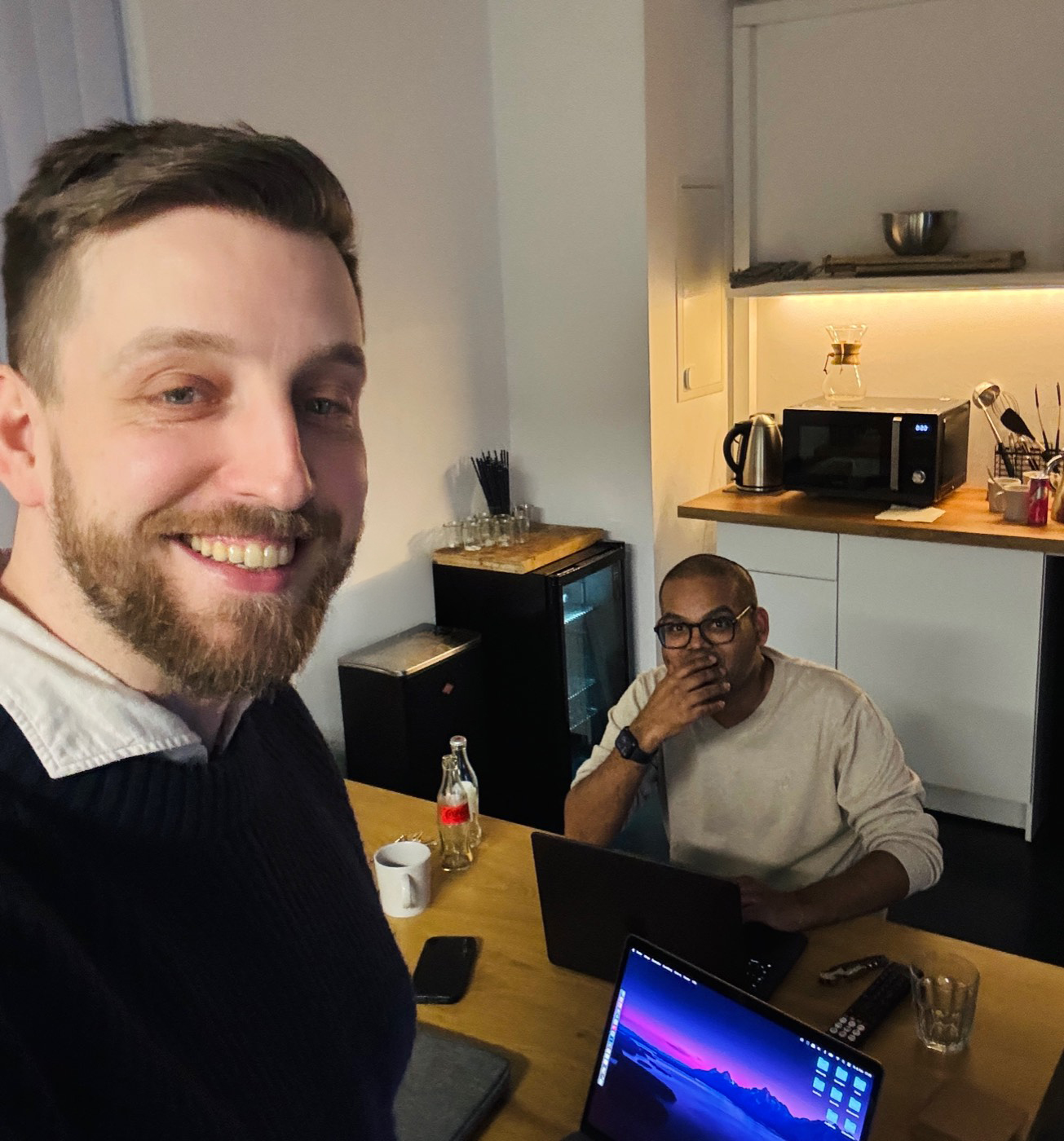
The moment that convinced us
Eventually we started showing capty to people outside the two of us.
What taught us most wasn't the reaction from social media professionals — they understood what we'd built, but they already know the problem. What convinced us was that people with no professional connection to social media could say what it was for within two minutes.
That was the signal. If someone with no background immediately sees the difference it makes to a company's day-to-day, the product explains itself. And then you have to build it.
Today, a good seven months on
The first version is live. You can connect your channels, set up your brand voice, upload photos and video, and turn them into posts written for each platform — scheduled, published, and routed through an approval first if someone on your team or on the client side needs to see it.
Now the honest part: this is a first version. There are corners that aren't smooth yet. There are features we already have in mind that aren't in there. Analytics ships as a beta on purpose, because we'd rather say plainly where we stand than pretend everything is finished.
But that's the part we're looking forward to most. We built capty because a tool was missing. Where it goes next isn't something we want to decide on our own — we want to decide it with the people using it. If something's missing, something irritates you, or something simply doesn't work: tell us. There's a ticket form under Help in the app that comes straight to us, not into a support funnel.
We read every one. There are two of us, so that's still manageable.
Thanks for being here.
Sascha & Michel
Want to try capty? Every plan comes with a free trial — here's the overview. And if you'd rather see how it all fits together first, our help centre walks you through each area step by step.